MSP NEWS Summer Course Highland to Ocean 2026 Successfully Held,...
Read MoreMacrozoobenthos, Mirror of Lake Health SDGs IPB University
Recent Post ...
IPB University Highlights Seagrass Potential for Sustainable Marine Ecotourism in Gili Air
Home Alumni Staff Undergraduate Postgraduate Profile Department MSP News Hamburger...
Read MoreShare
As a campus that upholds the concept of Campus Biodiversity, IPB University continues to strive to maintain the balance of the ecosystem in its campus environment.
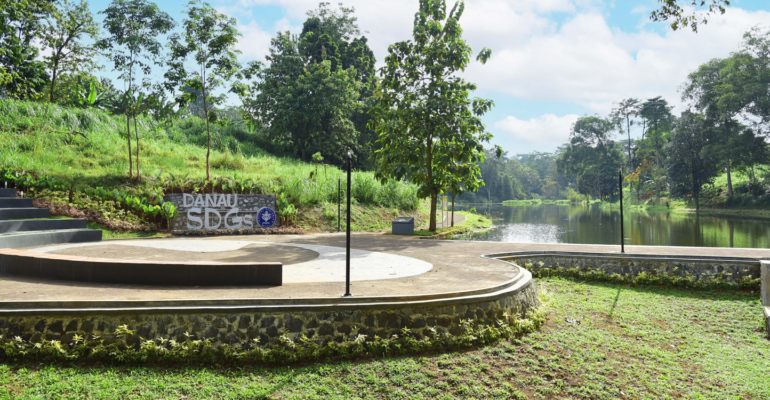
One concrete step taken is through water quality monitoring in SDGs Lake, IPB University Dramaga Campus. Interestingly, the monitoring is conducted by utilizing the animals living at the bottom of the water body, namely macrozoobenthos.
This research is part of the thesis of Raniah Nurainifitri Sukamto, a student of the Department of Aquatic Resources Management (MSP), Faculty of Fisheries and Marine Sciences (FPIK) IPB University, under the guidance of two lecturers, Prof Bambang Widigdo and Dr Majariana Krisanti.
“Macrozoobenthos are a group of organisms that live permanently on the bottom of water bodies. Due to their relatively immobile nature, the conditions of the water above them greatly affect their health and survival,” explained Dr Majariana Krisanti.
Macrozoobenthos, she continued, act as bioindicators, which are organisms whose presence can reflect the water quality conditions in their habitat. With these characteristics, the presence of macrozoobenthos can serve as a natural indicator to assess whether lake water is still healthy or beginning to be polluted.
The research was conducted at five observation points, taking into account the varying conditions in Lake SDGs. The results showed that areas with minimal human activity had the highest diversity of macrozoobenthos.
“Lake shores that have not been touched by humans, such as at the first station, produce better water quality as a habitat for macrozoobenthos,” said Dr Majariana Krisanti.
“Because there are no roads or human activities in the surrounding area, the environment there remains natural and supports the life of aquatic organisms,” she added.
In addition to human activity, the type of sediment or lake bed also affects the life of macrozoobenthos. If the sediment is too fine, such as mud, oxygen cannot easily enter and the life of aquatic organisms becomes limited.
According to Dr Majariana, maintaining vegetation around the lake is very important to prevent soil erosion and maintain water clarity. She also emphasized the importance of installing wastewater treatment facilities so that water from campus activities flowing into the lake remains clean and safe for the ecosystem.
As a relatively young artificial lake, Lake SDGs now serves more than just a water reservoir. It has become a learning space, a research site, and a place for recreation and environmental education for the academic community of IPB University.
Various activities such as bird watching, ecosystem studies, and nature-loving student activities are often carried out in this area, making it a tangible symbol of collaboration between science and conservation.
Dr Majariana concluded with an important message about the sustainability of environmental monitoring. “The hope is that this lake can live up to its name, so that IPB can add to its wealth of information related to both terrestrial and aquatic biodiversity campuses,” she said. (Am) (IAAS/LAN)
More News in Category: