@media screen and (max-width: 1024px) { .eael-hamburger–tablet { .eael-simple-menu-horizontal, .eael-simple-menu-vertical...
Read MoreDesigning a Blue Economy Curriculum, IPB University's Faculty of Fisheries and Marine Sciences (FPIK) Lecturers Establish Global Collaboration Through the STABLE Project
Recent Post ...
IPB University’s Faculty of Fisheries and Marine Sciences (FPIK) Lecturers Establish Global Collaboration Through the STABLE Project to Design a Blue Economy Curriculum
Home Alumni Staff Undergraduate Postgraduate Profile Department MSP News Hamburger...
Read MoreShare
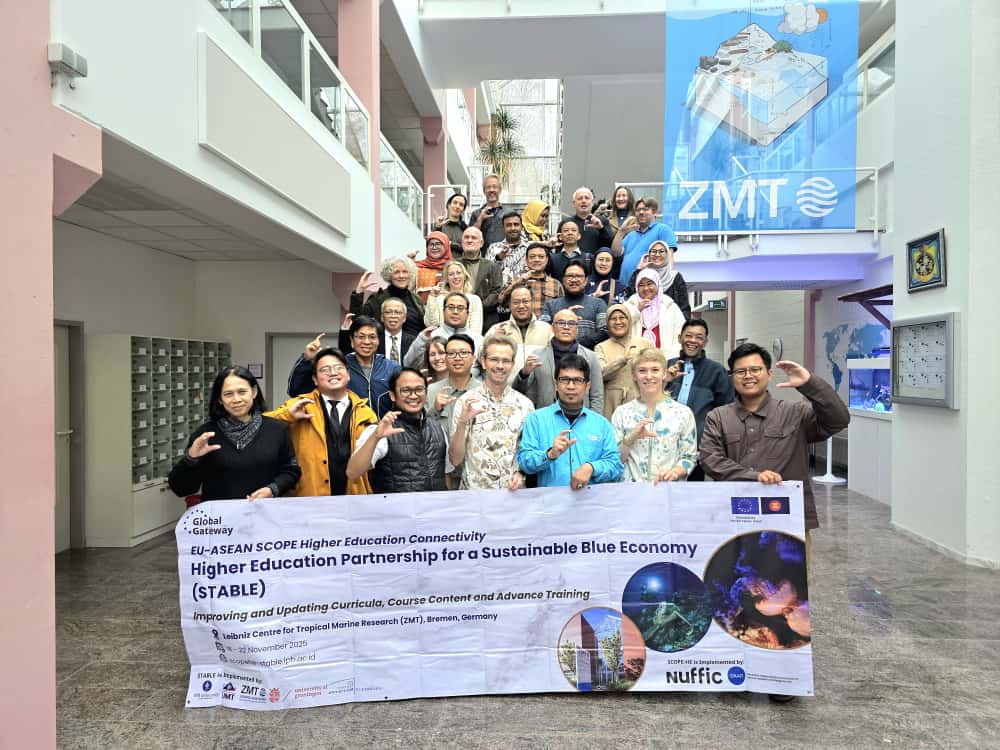
As a key part of its efforts to strengthen the competencies of Indonesian graduates in addressing the challenges of coastal and marine sustainability in the ASEAN region, IPB University, through the STABLE Project, initiated a Workshop on Curriculum, Course Content, and Advanced Training at the Leibniz Centre for Tropical Marine Research (ZMT) in Bremen, Germany (November 19–21).
The STABLE Project, or Higher Education Partnership for Blue Economy, is a strategic project under the EU-ASEAN SCOPE Higher Education Connectivity framework. The project is led by Prof. Hefni Effendi, Professor at the Faculty of Fisheries and Marine Sciences (FPIK) IPB University and Head of the Department of Aquatic Resources Management (MSP).
This workshop brought together academics: 19 lecturers from the Faculty of Fisheries and Marine Sciences (FPIK) of IPB University, four lecturers from Universiti Malaysia Terengganu, and several European partners from ZMT Bremen, the University of Bremen (Germany), and the University of Groningen (Netherlands). Prof. Dr. Raimund Bleischwitz, Director of ZMT, and Prof. Fredinan Yulianda, Dean of FPIK of IPB University, were present to welcome and officially open the event.
As the leader of the STABLE Project, Prof. Hefni Effendi elaborated on the comprehensive STABLE project, which will run for three years (2025–2027).
He explained that the academics are formulating the essential competencies needed by future graduates at both the undergraduate and postgraduate levels. On the first day, this process began with an interactive mapping exercise to define the blue economy, led by Rebecca Lahl from ZMT.
“We presented the curriculum of the Faculty of Fisheries and Marine Sciences (FPIK) of IPB University for four master’s programs: Coastal and Marine Resource Management (SPL), Aquatic Resource Management (SDP), Marine Science (IKL), and Marine Technology (TEK), along with five semester lesson plans (RPS) for each course,” explained Prof. Hefni.
Her presentation, she said, invited feedback on the integration of blue economy modules into the curriculum. Presentations from UMT (Master of Tropical Fisheries), the University of Bremen (Master of Marine Biology and Master of ISATEC/International Studies in Aquatic Tropical Ecology), and the University of Groningen (Master of Water and Coastal Management and Master of Marine Biology) also sparked discussions on lessons learned from previous curriculum changes. Future prospects in fisheries, marine science, social science inclusion, and the blue economy were also hot topics of discussion.
Participants also attended advanced training focused on broad aspects of research-based teaching in sustainable governance, fisheries, marine resources, marine conservation, blue carbon, transdisciplinarity, and the blue economy.
Experts provided input on the latest theories and tools for integration into teaching, covering topics such as impulses on the blue economy and ocean accounting; mangrove ecology and restoration; transdisciplinarity, tourism, wastewater; working with communities in water management; and Science LinX (connecting science and society).
We also covered the blue economy and ocean justice; transdisciplinarity, reef passages; fish ecology and evolution—teaching fish ecology at the University of Oldenburg; biodiversity monitoring and eDNA; artificial intelligence (AI) and remote sensing; scientific diving; environmental modeling for integrated scenario analysis; participation and research opportunities under Horizon Europe, Erasmus, Euraxess, and DAAD; and blue carbon.
“We also held an Internal Project Workshop to explore further collaboration in joint master’s and doctoral programs, joint research, student exchanges, summer schools, international symposia, and research dissemination,” said Prof. Hefni.
Participants also developed plans to apply their learnings to revise the curriculum and course content after gaining insights from their European partners. The program concluded with a visit to ZMT Bremen’s state-of-the-art Marine Experimental Ecology (MAREE) research facility.
More News in Category: