MSP NEWS Summer Course Highland to Ocean 2026 Successfully Held,...
Read MoreDept. ARM FFMS IPB University Student Research Promotes Sustainable Bilih Fish Management in Lake Singkarak Through a Co-management Approach
Recent Post ...
IPB University Highlights Seagrass Potential for Sustainable Marine Ecotourism in Gili Air
Home Alumni Staff Undergraduate Postgraduate Profile Department MSP News Hamburger...
Read MoreShare
July 31, 2026
Category:
Student
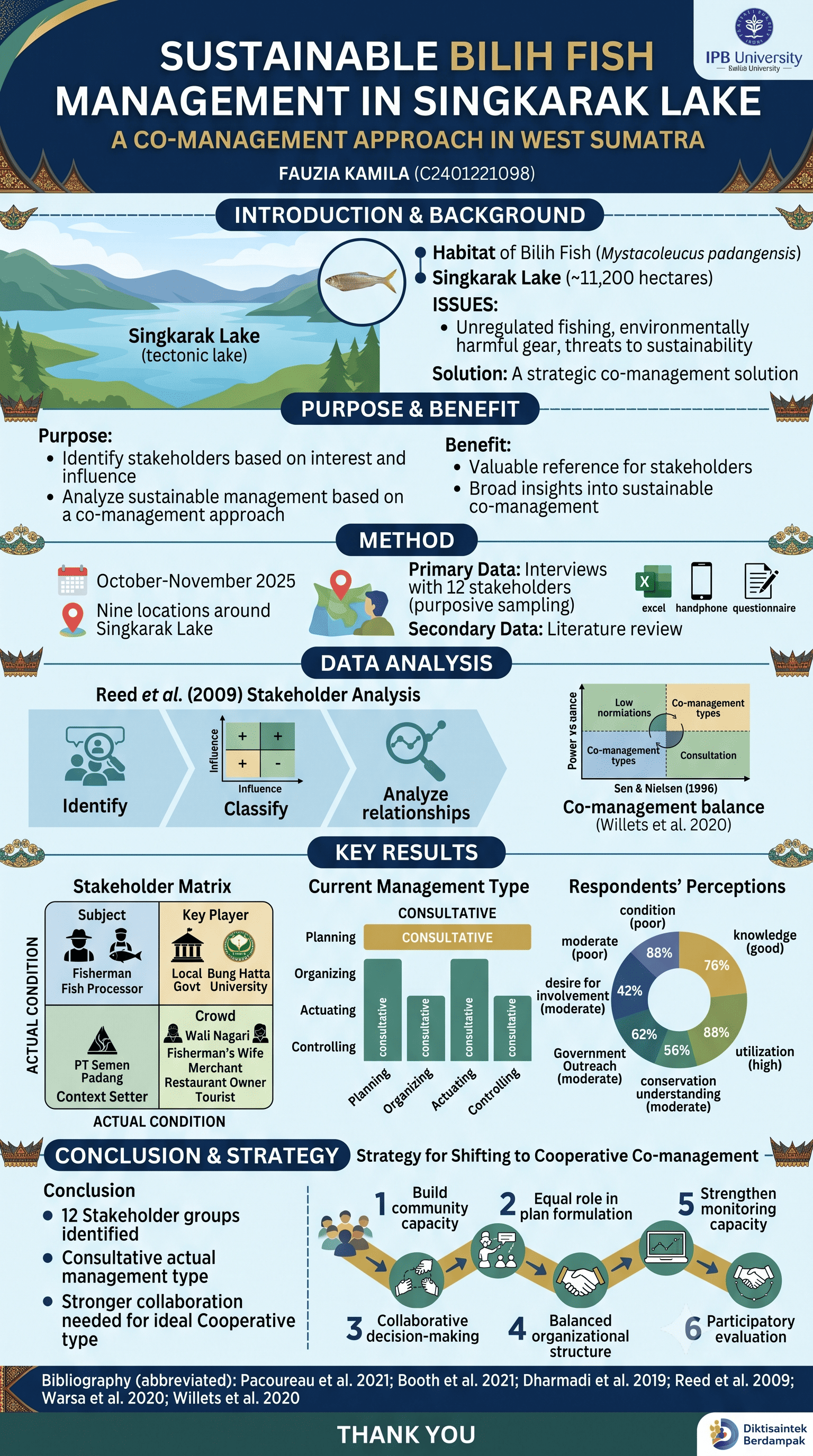
Bogor, Indonesia – As part of its commitment to advancing sustainable inland fisheries management, the Department of Aquatic Resources Management (MSP), Faculty of Fisheries and Marine Sciences, IPB University, continues to encourage student research addressing real-world environmental challenges. One such study was conducted by Fauzia Kamila (C2401221098), focusing on the sustainable management of Bilih fish (Mystacoleucus padangensis) in Lake Singkarak, West Sumatra.
Lake Singkarak, Indonesia’s largest tectonic lake in Sumatra, is the natural habitat of the endemic Bilih fish, a species of considerable ecological and economic importance. However, increasing pressure from unregulated fishing practices, environmentally harmful fishing gear, and other anthropogenic activities has raised concerns regarding the long-term sustainability of its fishery resources.
The study aimed to identify key stakeholders based on their interests and influence while assessing the current fisheries management system using a co-management approach. The research is expected to provide valuable insights for policymakers, local communities, and other stakeholders in developing more collaborative and sustainable fisheries governance.
Fieldwork was conducted between October and November 2025 across nine locations surrounding Lake Singkarak. Primary data were collected through interviews with 12 stakeholders selected using purposive sampling, while secondary data were obtained through an extensive literature review. Stakeholder relationships were analyzed using the framework developed by Reed et al. (2009), alongside the co-management typology proposed by Sen and Nielsen (1996) and further developed by Willetts et al. (2020).
The findings identified 12 stakeholder groups involved in the management of the Bilih fishery, including fishermen, fish processors, local government agencies, Bung Hatta University, PT Semen Padang, merchants, tourism operators, and community representatives. The analysis revealed that the existing management system is predominantly consultative, where stakeholders are consulted but have limited influence over decision-making processes.
Based on these findings, the study recommends transitioning toward a cooperative co-management model by strengthening community capacity, ensuring equal stakeholder participation in policy formulation, promoting collaborative decision-making, improving institutional arrangements, enhancing monitoring capacity, and implementing participatory evaluation mechanisms.
This research highlights that sustainable inland fisheries management depends not only on government policies but also on meaningful collaboration among all stakeholders. By fostering a cooperative co-management framework, the conservation and sustainable utilization of Bilih fish in Lake Singkarak can be better achieved, benefiting both local communities and the aquatic ecosystem.
More News in Category: