MSP NEWS Summer Course Highland to Ocean 2026 Successfully Held,...
Read MoreIPB University Highlights Seagrass Potential for Sustainable Marine Ecotourism in Gili Air
Recent Post ...
IPB University Highlights Seagrass Potential for Sustainable Marine Ecotourism in Gili Air
Home Alumni Staff Undergraduate Postgraduate Profile Department MSP News Hamburger...
Read MoreShare
August 11, 2026
Category:
Student
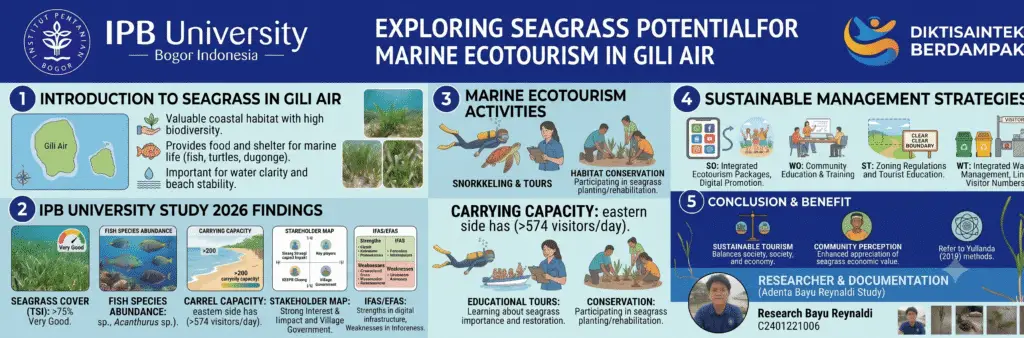
BOGOR, INDONESIA — The seagrass ecosystem of Gili Air, West Nusa Tenggara, holds significant potential to support the development of sustainable marine ecotourism. This finding emerged from a 2026 study conducted by IPB University researcher Adenta Bayu Reynaldi, which explored the ecological condition of seagrass habitats, fish abundance, tourism carrying capacity, stakeholder involvement, and management strategies for sustainable marine ecotourism in Gili Air.
Seagrass ecosystems are among the most important coastal habitats, supporting marine biodiversity while providing ecological benefits for coastal communities. In Gili Air, the study found that seagrass cover was in the “Very Good” category, with coverage exceeding 75 percent. This healthy seagrass habitat provides food and shelter for various marine organisms, including fish, sea turtles, and dugongs. It also contributes to maintaining water clarity and coastal stability.
The study further identified the presence of fish species associated with the seagrass ecosystem, including Acanthurus sp. The ecological condition of the area provides an important foundation for developing tourism activities that combine recreation, environmental education, and conservation.
One of the key findings of the study is the tourism carrying capacity of the eastern side of Gili Air. The area has the potential to accommodate more than 574 visitors per day, indicating considerable opportunities for tourism development while emphasizing the importance of managing visitor numbers within environmentally sustainable limits.
Based on these findings, several marine ecotourism activities can be developed in Gili Air. These include guided snorkeling and marine tours, educational tours focusing on the ecological importance of seagrass, and habitat conservation activities such as seagrass planting and rehabilitation. Such activities can provide visitors with direct experiences of marine ecosystems while encouraging greater awareness of conservation.
The research also examined the roles and interests of different stakeholders in the management of Gili Air. The stakeholder analysis identified strong interest and influence among key actors, including the village government and other relevant stakeholders. Their involvement is considered essential to ensure that tourism development is aligned with local interests and conservation objectives.
To strengthen sustainable tourism management, the study proposes several strategic approaches. These include the development of integrated ecotourism packages and digital promotion, community education and training, zoning regulations and tourist education, as well as integrated waste management and visitor-number limitations. Digital infrastructure was also identified as one of the strengths that can be utilized to promote sustainable tourism experiences in Gili Air.
The proposed strategies aim to establish a balance between environmental conservation, community interests, and economic benefits. By integrating conservation into tourism activities, visitors can enjoy the natural attractions of Gili Air while gaining a better understanding of the ecological and economic value of seagrass ecosystems.
The study emphasizes that sustainable marine ecotourism should not only focus on increasing visitor numbers, but also on strengthening community participation and protecting the ecosystems that support tourism itself. With appropriate planning and collaborative management, Gili Air’s seagrass ecosystems can become an important asset for both marine conservation and sustainable local tourism development.
More News in Category: