MSP NEWS Summer Course Highland to Ocean 2026 Successfully Held,...
Read MoreDepartment of Aquatic Resources Management Highlights River Ecosystem Health Assessment Through Macrozoobenthos Bioindicators
Recent Post ...
IPB University Highlights Seagrass Potential for Sustainable Marine Ecotourism in Gili Air
Home Alumni Staff Undergraduate Postgraduate Profile Department MSP News Hamburger...
Read MoreShare
August 5, 2026
Category:
Student
Bogor, Indonesia – The health of a river ecosystem can be effectively assessed by examining the composition and diversity of macrozoobenthos, a group of benthic invertebrates that inhabit river substrates. As organisms that respond sensitively to environmental changes, macrozoobenthos serve as reliable bioindicators of water quality and ecosystem conditions.
This competency represents one of the core areas of expertise taught and developed at the Department of Aquatic Resources Management (MSP), Faculty of Fisheries and Marine Sciences (FPIK), IPB University. Through research and field-based learning, students are trained to assess aquatic ecosystem health using biological indicators alongside physicochemical water quality parameters.
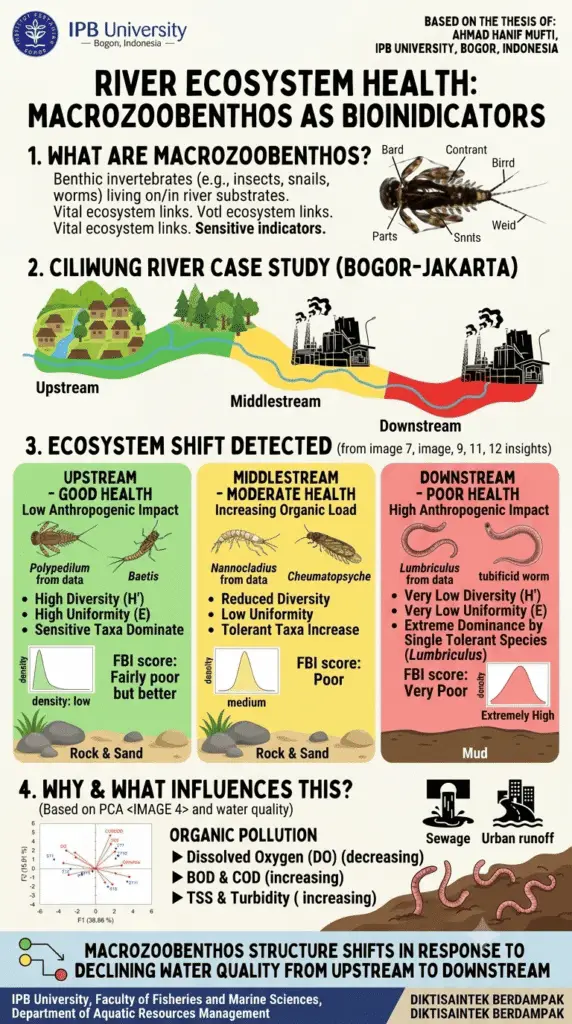
One example is the study conducted by Ahmad Hanif Mufti, which investigated macrozoobenthos communities along the Ciliwung River, stretching from Bogor to Jakarta. The study revealed a clear ecological gradient from upstream to downstream. The upstream section, characterized by relatively low anthropogenic disturbance, supported high macrozoobenthos diversity and was dominated by pollution-sensitive taxa such as Polypedilum and Baetis. In contrast, the middle section showed moderate ecological degradation due to increasing organic loads, while the downstream area exhibited poor ecosystem health, where pollution-tolerant organisms such as Lumbriculus and tubificid worms became dominant.
The findings also demonstrated that declining dissolved oxygen (DO), accompanied by increasing Biological Oxygen Demand (BOD), Chemical Oxygen Demand (COD), Total Suspended Solids (TSS), and turbidity, strongly influenced changes in macrozoobenthos community structure. These environmental pressures reflect the impacts of urban runoff, domestic sewage, and other anthropogenic activities along the river.
By integrating biological assessments with water quality analysis, the Department of Aquatic Resources Management continues to strengthen students’ competencies in freshwater ecosystem monitoring and sustainable river management. This approach equips future aquatic resource professionals with the scientific knowledge and practical skills needed to support evidence-based conservation and water resource management in Indonesia.
More News in Category: