MSP NEWS Summer Course Highland to Ocean 2026 Successfully Held,...
Read MoreMangrove Health and Macrozoobenthos Community: MSP Student Research Supports Sustainable Mangrove Ecosystem Management
Recent Post ...
IPB University Highlights Seagrass Potential for Sustainable Marine Ecotourism in Gili Air
Home Alumni Staff Undergraduate Postgraduate Profile Department MSP News Hamburger...
Read MoreShare
July 11, 2026
Category:
Student
Bogor – Assessing the health of mangrove ecosystems and understanding their relationship with macrozoobenthic communities are among the core competencies taught in the Department of Aquatic Resources Management (MSP), Faculty of Fisheries and Marine Sciences (FPIK), IPB University. These competencies equip students with the scientific knowledge and practical skills needed to evaluate coastal ecosystem conditions and formulate evidence-based management strategies for sustainable environmental conservation.
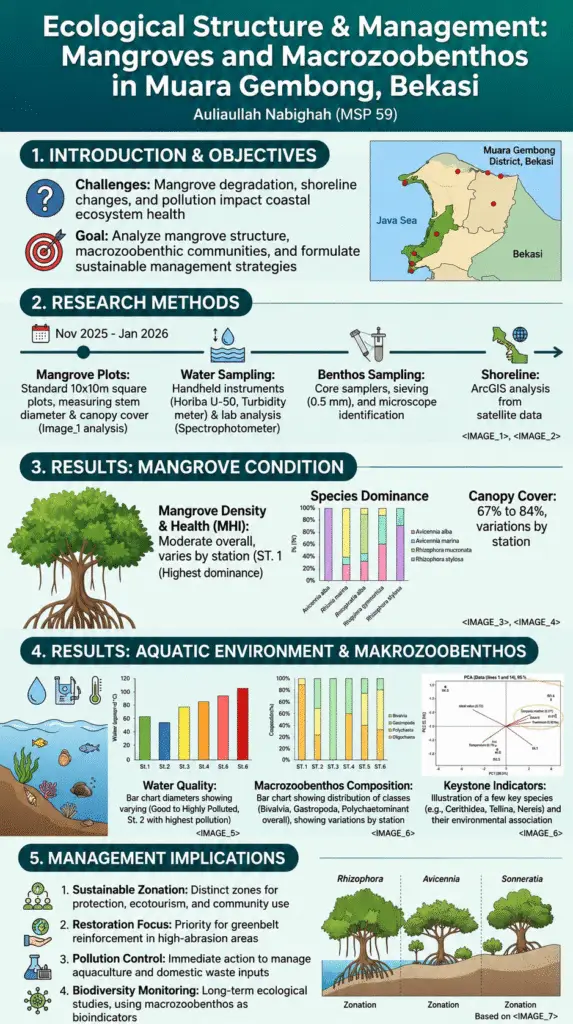
One example of this academic excellence is demonstrated through the undergraduate research conducted by Auliaullah Nabighah (MSP 59), entitled “Ecological Structure of Mangroves and Macrozoobenthic Communities and Their Implications for Mangrove Ecosystem Management in Muara Gembong, Bekasi.” The study highlights the integration of ecological assessment techniques with environmental management approaches to better understand the dynamics of mangrove ecosystems in one of Indonesia’s important coastal regions.
The research was carried out in Muara Gembong, Bekasi, an area that has experienced increasing environmental pressures due to mangrove degradation, shoreline changes, and pollution. These challenges have affected the ecological balance of coastal habitats, making scientific assessment and sustainable management increasingly important.
Using a comprehensive field-based approach, the study analyzed mangrove vegetation structure, macrozoobenthic community composition, water quality, and shoreline dynamics. Data collection involved vegetation surveys, water quality measurements, macrozoobenthos sampling, laboratory analyses, and spatial analysis using Geographic Information Systems (GIS) and satellite imagery. This multidisciplinary methodology enabled a holistic evaluation of ecosystem health and environmental conditions.
The findings revealed that mangrove conditions varied among observation stations, with moderate overall ecosystem health indicated by the Mangrove Health Index (MHI). Differences in mangrove species composition and canopy cover reflected the ecological characteristics of each site. The study also documented variations in macrozoobenthic communities, demonstrating that benthic organisms can serve as valuable bioindicators for assessing environmental quality and ecosystem changes.
Furthermore, the research identified important relationships between water quality, mangrove condition, and macrozoobenthic distribution. These findings provide scientific evidence that healthy mangrove ecosystems support diverse benthic communities, while environmental disturbances can significantly influence biodiversity and ecosystem functioning.
Based on the research outcomes, several management recommendations were proposed, including strengthening mangrove zonation according to ecological functions, prioritizing restoration in degraded coastal areas, improving pollution control measures, and implementing long-term biodiversity monitoring using macrozoobenthos as ecological indicators. These recommendations are expected to contribute to sustainable coastal ecosystem management in Muara Gembong and other mangrove areas facing similar environmental challenges.
According to Prof. Hefni Effendi, the ability to assess mangrove health in relation to macrozoobenthic communities represents one of the distinctive scientific competencies developed within the Department of Aquatic Resources Management. He expressed his appreciation for Auliaullah Nabighah’s research, noting that it demonstrates how students are able to apply ecological theories and field-based scientific methods to address real-world environmental challenges while generating knowledge that supports sustainable coastal resource management.
Through research activities such as this, the Department of Aquatic Resources Management, FPIK IPB University continues to encourage students to produce high-quality scientific work that not only advances academic knowledge but also provides practical contributions to environmental conservation and evidence-based policy development.
More News in Category: